


Who Was Pamela Colman Smith?
Pamela Colman Smith (1878–1951), often affectionately called “Pixie,” was an artist, illustrator, writer and member of the Hermetic Order of the Golden Dawn.
Born in London and raised partly in Jamaica and the United States, Smith was influenced by theatre, folklore and visual storytelling. Her artistic style was expressive, fluid and emotionally charged — qualities that later became central to the Rider-Waite tarot deck.
In 1909, she was commissioned by Arthur Edward Waite to illustrate a new tarot deck that would embody Golden Dawn symbolism while remaining accessible to the public. Unlike earlier decks such as the Marseille tradition — which used simple suit symbols for the Minor Arcana — Smith was tasked with illustrating all 78 cards as narrative scenes.
This decision changed tarot permanently.
The Revolutionary Minor Arcana
Before Smith’s illustrations, most Minor Arcana cards simply displayed repeated suit symbols: cups, swords, wands or coins arranged in patterns.
Smith transformed these into scenes filled with:
Body language
Emotional expression
Environmental cues
Movement and tension
Implied storylines
For example:
The Three of Swords became a pierced heart against a stormy sky.
The Five of Pentacles became figures walking past a lit church window in hardship.
The Ten of Wands showed a figure burdened and struggling forward.
These images allow readers to interpret energy and emotion without memorising keywords.
This shift made tarot more intuitive and psychologically accessible.
Symbolism, Theatre and Emotional Storytelling
Smith’s background in theatre influenced the dramatic staging of her images. Many cards feel like scenes paused mid-narrative.
Her work allows you to ask:
What just happened?
What is about to happen next?
Who holds power in this scene?
What emotion is dominant?
This theatrical framing encourages active interpretation rather than passive memorisation.
Even colour plays a role. Warm yellows suggest clarity or vitality. Grey skies imply tension or uncertainty. The positioning of figures creates dynamic energy between characters.
Modern readers often describe tarot as “telling a story.” That storytelling instinct originates largely from Smith’s artistic vision.
Recognition and Historical Overshadowing
For decades, Smith’s contribution was overshadowed by Waite’s name and the publishing company Rider & Son.
The deck became widely known as “Rider-Waite,” leaving Smith unacknowledged in mainstream reference.
In recent years, tarot scholarship and communities have worked to restore recognition, referring to the deck as Rider-Waite-Smith.
This shift matters.
It acknowledges that tarot is not only a symbolic system — it is also an artistic creation shaped by a woman whose visual language defined modern tarot practice.
Practical Application
How to work with this
Nearly every modern deck either directly imitates or is influenced by Smith’s illustrated Minor Arcana.
When you:
Read emotional nuance in the Cups
See conflict in the Swords
Recognise burden in the Wands
Notice material themes in the Pentacles
You are working within the visual grammar she created.
Understanding her influence makes you a more conscious reader. You begin to notice not just what a card “means,” but how imagery communicates meaning.
Related Links
Card
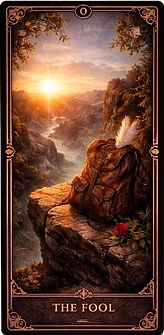
0 The Fool
Card

Ten of Wands
Card

Three of Swords
Card
Five of Pentacles
Suits

Pentacles
Suits

Wands
Suits

Swords
Suits

Cups
Spreads

Past / Present / Future (3 Cards)
Spreads

Mind / Body / Spirit (3 Cards)
Spreads
